

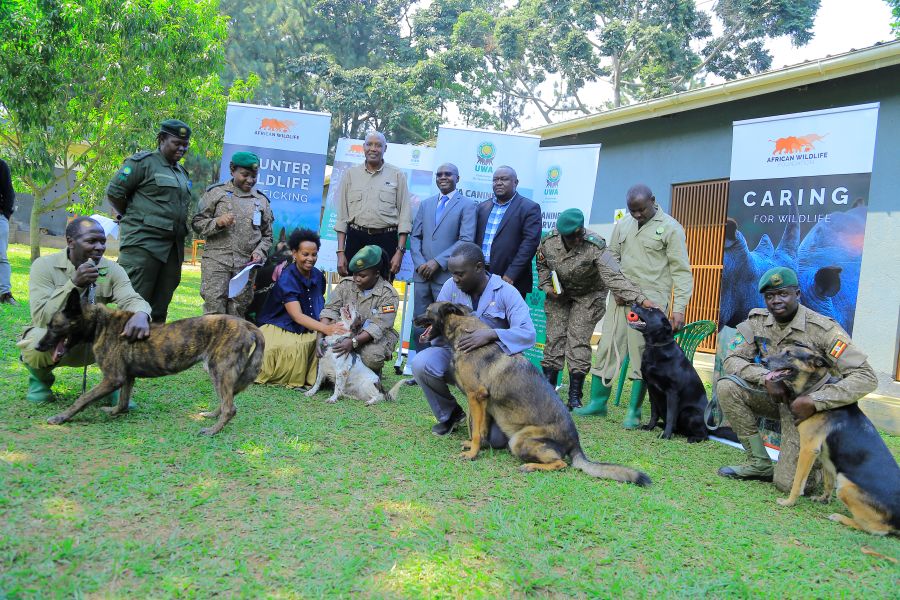
The Uganda Wildlife Authority (UWA) has officially assumed full control of the country’s canine detection units in Entebbe and Karuma, securing the future of one of Africa’s most effective anti-trafficking tools.
This transition, made possible through nine years of collaboration with the African Wildlife Foundation (AWF) under the Canines for Conservation Program, ensures that Uganda’s battle against illegal wildlife trade will now be nationally led and sustained for years to come.
The handover was celebrated at the Uganda Wildlife Conservation Education Centre (UWEC) in Entebbe, where UWA formally integrated the canine program into its operations.
“Nine years ago, we introduced canine detection to Uganda when trafficking networks were becoming increasingly sophisticated. The results speak for themselves: trained handlers, proven facilities, and dogs that have intercepted wildlife products before they could leave the country. Today’s handover confirms that Uganda has both the capacity and commitment to carry this work forward," said Kaddu Sebunya, CEO of AWF.
"We are not necessarily pulling out but we believe the responsibility of taking care of African wildlife belongs to governments and citizens of those countries. UWA taking over symbolises the same."
Established in 2016, the Canines for Conservation Program was launched in response to Uganda’s vulnerability to wildlife trafficking—an issue that placed the country on the global red list.
Speaking during the same function, the UWA Director for Field Operations Charles Tumwesigye said the program has played a vital role in Uganda’s remarkable progress, contributing to national efforts to combat wildlife crime.
"Before the launch of the program, there was an upsurge in illegal trade of ivory and Uganda was named among 8 countries involved in illegal ivory trade. Uganda was source and transit market for illegal ivory trade and asked to do something about it. Illegal ivory would pass Entebbe Airport and would be detected from Nairobi or Asia. However, with the Canines for Conservation Program, the results have been amazing," Tumwesigye said.
"We have had so many arrests at airport and inside the country as a result of the canine unit. You can bribe a human being but not a dog to allow you to pass ivory. It is trained that if it detects a contraband it will show a sign and it does the same."
He said the program didnt not only help train UWA staff plus getting dogs for detecting illegal wildlife trophies , it also helped in tracking poachers.
"Because of the success of this program, Uganda which had been blacklisted was removed after we showed world we have mechanisms in place to combat illegal wildlife Uganda demonstrated it has capability. We strengthened intelligence and investigations ."
The head of the canine unit at UWA, Imelda Imetur spoke of the benefits of the program.
"We are now using dogs to follow the poachers. They only need to pick a scent and follow a poacher. As Uganda we cant thump our chests that we are there but have demonstrated we can control illegal trade. We are grateful to AWF for the support they have given us," she said.
She explained that before the program was introduced, at least five people were arrested daily for trafficking in illegal wildlife, noting that the number reduced to one suspect a day to now going a week without arresting any.
" We thank African wildlife foundation for helping start the unit and pushing us for these nine years. Right from the world go they helped build our capacity . Over the years we have made tremendous achievements. We have made over 360 arrests and many of these prosecuted in courts of law. We also ventured into intelligence led operations where we get intelligence information, follow it up and lead to arrest of culprits. We are happy of the results," Imetur said.
She said when the program was launched in 2016 at Karuma in the Murchison Falls Conservation Area with specialized tracker dogs as a pilot, little did they know it would become a cornerstone of Uganda’s anti-trafficking strategy.
"A total of 28 rangers have been trained as handlers, 14 highly skilled dogs have been deployed, and purpose-built facilities with kennels, handler housing, and operations rooms have been established. Between 2016 and 2018, the canine units recorded their highest number of seizures, intercepting wildlife products in 86 cases involving cargo, luggage, and vehicles. These operations not only disrupted trafficking networks but also provided court-admissible evidence, leading to successful prosecutions," she noted.
According to officials, the program has also elevated standards in ranger training, including animal welfare, crime scene management, and courtroom testimony.
Handlers are now recognized as first responders in wildlife crime cases, ensuring that evidence is preserved and prosecutions are strengthened.
The AWF CEO said their philosophy has been to build local ownership, noting that the canine dogs, facilities, and equipment have always belonged to the government of Uganda.
"Our role has been to provide technical expertise, training, and financial support, while preparing UWA to take full ownership. Today, that vision has come full circle. UWA has integrated canine operations into its structure, created positions for canine masters, and committed resources to sustaining this work," Ssebunya said.
He said this milestone puts Uganda alongside other countries, such as Botswana, Mozambique and Cameroon, where AWF has transitioned programs into national ownership, with Kenya, and Tanzania to follow.
"And yet, this is not a departure. Even as we reduce our direct role in the Canine programme, AWF’s commitment still remains."
Rose Ssebatindira, AWF’s Uganda Country Director, emphasized said the canine units have become part of Uganda’s identity in the fight against wildlife crime.
"They have shown that with the right tools and training, Ugandan rangers and law enforcement agencies can match and outpace traffickers.”
The transition
The transition comes as UWA fully embeds the canine program into its organizational structure. Dedicated positions for canine masters and unit leaders have been created, and budgetary resources now cover replacement dogs, training, and operations.
This ensures the program continues beyond donor support as a permanent feature of UWA’s long-term enforcement strategy.
During the same function, AWF donated three additional trained dogs to strengthen the capacity of the Entebbe and Karuma units and according to CEO, Kaddu Ssebunya, they will serve as a bridge between past investments and future enforcement successes.
UWA director for field operations, Charles Tumwesigye said they are ready to take over the mantle from AWF.
"From today we are taking over this program fully and I want to assure everyone that we have the capacity to handle the activities. I want to assure AWF that we shall carry the program further and strengthen it. Uganda will no longer be used as conduit for illegal wildlife trafficking,"
Celebrating the Transition
During the Entebbe ceremony, guests witnessed a live demonstration at the airport, where detection dogs showcased their ability to uncover concealed contraband.
A second event is scheduled for Karuma on September 5, 2025, featuring tracker dogs in action in the field. These demonstrations highlight the effectiveness of Uganda’s canine-led enforcement capacity.
By handing over full ownership to UWA, AWF concludes nearly a decade of direct implementation while ensuring that Uganda retains the tools, skills, and institutional frameworks to sustain canine-led enforcement.